Description:
Esomeprazole, the S-isomer of Omeprazole, reduces gastric acid secretion through specific inhibition of the acid pump in the parietal cell, where it is concentrated and converted to the active form in the acid environment of the secretary canaliculi and inhibits the enzyme H+K+ATPase -the acid pump.
Composition:
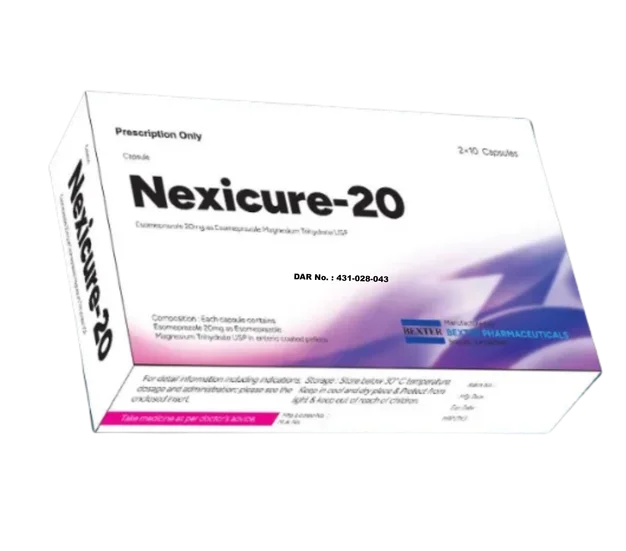
Each capsule contains Esomeprazole 20mg as Esomeprazole Magnesium Trihydrate USP in enteric coated pellets.
Indication:
The FDA approved Esomeprazole for maintenance of healing of erosive esophagitis and in combination with Amoxicillin and Clarithromycin, for the eradication of Helicobacter pylori infection in patients with duodenal ulcer disease. The FDA approved Esomeprazole for risk reduction of NSAID induced stomach ulcer.
Esomeprazole capsules are indicated for:
• Treatment of Gastroesophageal Reflux Disease (GERD)
• Healing of Erosive Esophagitis
• Maintenance of Healing of Erosive Esophagitis
• Symptomatic Gastroesophageal Reflux Disease (GERD)
• Risk reduction of NSAID-associated gastric ulcer
• H. pylori eradication to reduce the risk of duodenal ulcer disease and recurrence in combination with Amoxicillin and Clarithromycin
• Pathological hypersecretory conditions (including Zollinger Ellison Syndrome)
Dosage & Administration:
The capsule should be swallowed whole with liquid. The capsule should not be chewed or crushed and should be taken one hour before meal.
Gastroesophageal Reflux Disease (GERD):
1. Healing of Erosive Esophagitis - 20mg or 40mg - Once daily for 4 to 8 weeks*
2. Maintenance of Healing of Erosive Esophagitis - 20mg - Once Daily**
3. Symptomatic Gastroesophageal Reflux - 20mg - Once daily for 4 weeks***
4. Risk reduction of NSAID associated gastric ulcer - 20mg or 40mg - Once Daily for up to 6 Months**
Triple Therapy for H. pylori Eradication:
1. Esomeprazole - 20 mg or 40 mg - Twice daily for 7 days or Once daily for 10 days
2. Amoxycillin - 1000mg - Twice daily for 7/10 days
3. Clarithromycin - 500mg - Twice daily for 7/10 days
Drug Interaction:
Absorption of Ketoconazole and Itraconazole may decrease during treatment with Esomeprazole. Plasma concentrations of Diazepam, Citalopram, Imipramine, Clomipramine, Phenytoin etc. may be increased, requiring potential dose adjustment.
Side Effects:
More frequent: Headache, abdominal pain, diarrhea, flatulence, nausea & vomiting.
Less frequent: Dermatitis, pruritus, urticaria, dizziness.
Contraindications:
Known hypersensitivity to Esomeprazole or any other constituents of the formulation.
Pregnancy & Lactation:
US FDA Pregnancy Category: B.
Teratology studies have been performed in animals and have revealed no evidence of impaired fertility or harm to the fetus due to Esomeprazole. Esomeprazole should be used during pregnancy if the potential benefit justifies the potential risk. There are, however, no adequate and well controlled studies in pregnant women. Because animal reproduction studies are not always predictive of human response, this drug should be used during pregnancy only if clearly needed. Because Esomeprazole is likely to be excreted in human milk, a decision should be made whether to discontinue nursing or to discontinue the drug, taking into account the importance of the drug to the mother.
Storage Conditions:
Store in a cool (below 25°C) and dry place, protected from light & moisture.
Precaution & Caution:
Symptomatic response does not preclude the presence of gastric malignancy. Acute interstitial nephritis has been observed in patients taking PPIs. Cyanocobalamin (vitamin B12) deficiency: Daily long-term use (e.g., longer than 3 years) may lead to malabsorption or a deficiency of cyanocobalamin. PPI therapy may be associated with increased risk of Clostridium difficile associated diarrhea.
Pack Size:
3 x 10 Capsules (Alu-Alu Blister)

(0) Reviews: